There’s an interesting trend making the rounds about how Millennials versus Gen Z do marketing. (They haven’t bothered to compare Gen-X, and I think I’m glad.)
The “Millennial” version is usually polished, aspirational, carefully worded, and emotionally warm.
The “Gen Z” version?
There’s all-lowercase captions, blunt language, self-aware humor, meme energy… Sometimes it looks like someone handed the brand account to the intern with the best Wi-Fi and the least concept of consequences.
And yet, here’s the irony: Gen Z marketers have managed to do very naturally what senior-most executives have begged me to help their teams do better since I began coaching 18 years ago:
They know how to get to the point.
Here’s a great example:
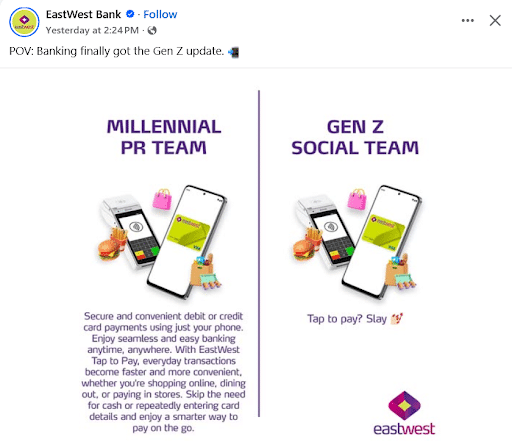
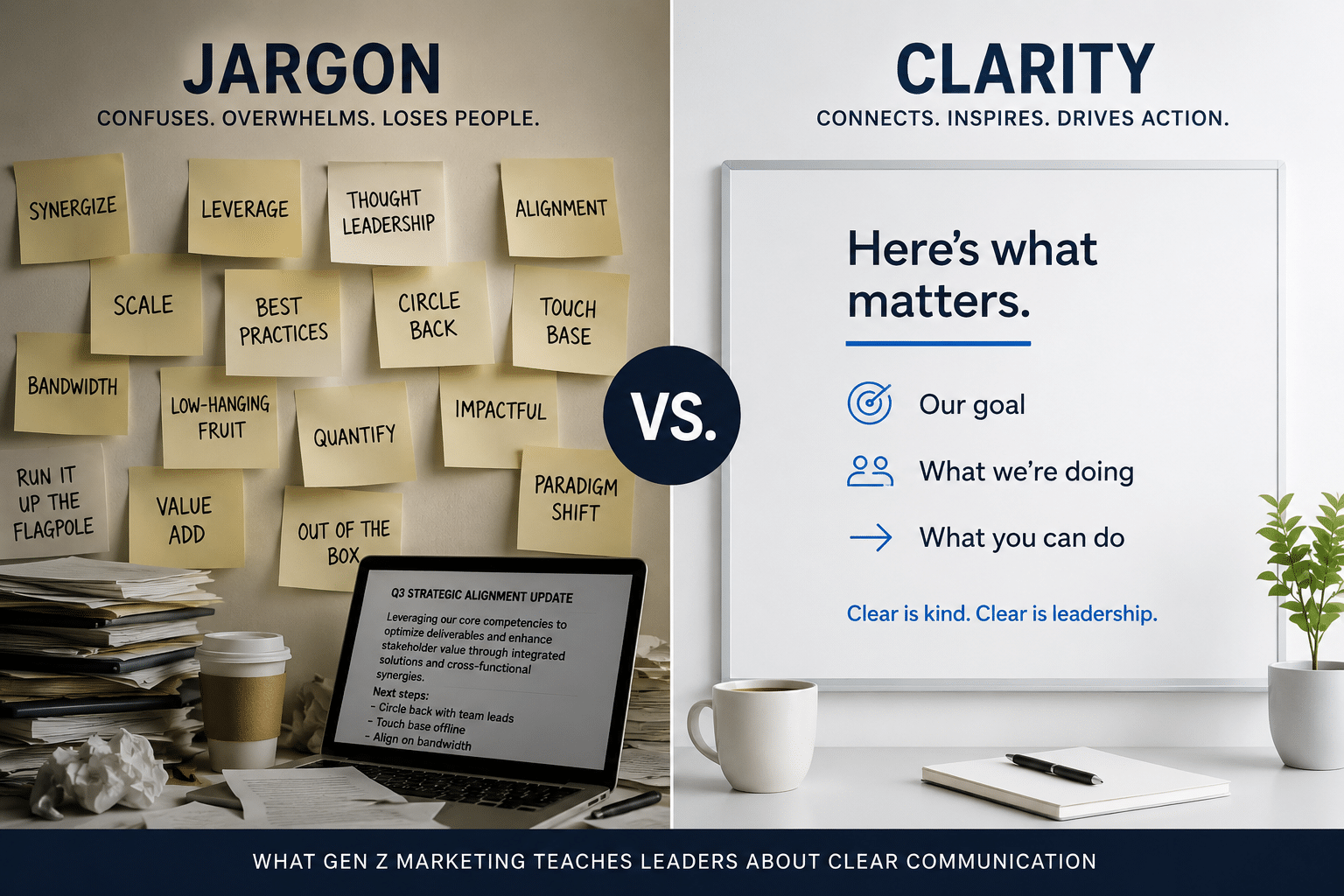
Gen Z Marketing Gets to the Point
At first glance, these posts look unsophisticated, even trite. But underneath the seemingly-simplistic facade is a serious leadership communication lesson.
The best Gen Z-style marketing does not make the audience work hard.
It does not bury the message under layers of details.
It does not leave people wearing that facial expression that looks like they’re trying to do long division in their head.
Instead, the message lands instantly.
The intended audience gets it.
No “carry the one” required.
That matters because clarity is not just a marketing skill. Clarity is a leadership skill.
Whether you are selling chicken sandwiches, pitching a new software platform, presenting quarterly results, asking for funding, or trying to get your executive team aligned around a strategic initiative, the same rule applies:
If your audience has to work too hard to understand you, your influence is already leaking.
Albert Einstein is often credited with saying, “If you can’t explain it simply, you don’t understand it well enough.”
Whether or not every brilliant technical expert wants to hear that is another matter.
The Expert’s Curse: Why Smart People Overcomplicate Ideas
This is the premise of one of my most popular training programs today, “Breaking the Expert’s Curse.”
And no, it is not designed primarily for people with “marketing” in their job title.
It is for technical experts, senior leaders, analysts, physicians, engineers, scientists, finance professionals, consultants, and others who may not think of themselves as marketers, but who still have to “market” their ideas every day.
They have to get buy-in.
They have to earn trust.
They have to persuade decision-makers.
They have to translate complexity into action.
The problem is that when people are deeply knowledgeable, they often cling tightly to the superhero cape of jargon, acronyms, caveats, data points, and technical detail.
It feels safer that way. It feels more credible. It feels like, “If I tell you everything I know, surely you will understand why I’m right.”
But more information does not automatically create more clarity. Often, it creates cognitive overload, confusion and resistance.
The challenge is that simplifying your message can make you feel like you're making it less compelling or authoritative.
It’s not.
Simplifying is not dumbing it down.
Simplifying is translating.

Simplifying Builds Executive Presence
When you simplify well, you are not insulting your audience’s intelligence. You are respecting their time, attention, and priorities.
You are saying, “I understand this deeply enough that I can help you understand what matters most.”
That is the difference between sounding like someone who is trying to prove they get it and sounding like someone who actually does.
This is why Gen Z marketing works so well when done right. It speaks the language of its audience. It removes unnecessary friction. It does not try to sound impressive. It tries to be understood.
For years, many executives have been taught, directly or indirectly, that executive presence means sounding formal, polished, and important.
Sure, there is a place for polish. But polish without clarity is just expensive confusion.
Real executive presence is not about sounding distant or untouchable. It is about being credible, grounded, and connected.
When you can make a complex point so clearly and confidently that your audience intuitively understands it, there is tremendous power in that.
It says, “I do not need to hide behind big words, technical mumbo-jumbo, or 47-slide appendices. I can make this point so clearly that you just know I’m right.”
That kind of clarity hits all three Cs of my Vocal Executive Presence model:
Command the room.
Connect with the audience.
Close the deal.
Because people rarely buy into what they cannot understand.
Speak the Language of Your Audience
To be clear, I am not suggesting executives should start saying “slay” in board meetings.
Please don’t.
Nobody wants the CEO opening an earnings call with, “Okay besties, Q3 was giving chaos.”
The lesson is not to imitate Gen Z slang. The lesson is to understand why the communication works.
- It is audience-centered.
- It is direct.
- It is conversational.
- It reduces the distance between the message and the listener.
That is what great leadership communication does too.
The best leaders do not ask, “How do I sound smart?”
They ask, “What does this audience need to hear, in what language, so they can understand, trust, and act on it?”
That is the shift.
Closing the Gap Between What You Said and What They Heard
This is exactly what Michael Reddington and I discussed on the I See What You’re Saying: The Disciplined Listening Podcast.

The heart of that conversation was how to close the gap between what you think you said and what your audience actually heard.
Because those are not always the same thing.
We talked about overcoming “the expert’s curse,” translating expertise, establishing credibility, and aligning your words, voice, and body language so your message lands with clarity and impact.
Listen in on your favorite platform:
That is the real leadership lesson hiding inside this Gen Z marketing trend.
Every generation reshapes the language of influence. The next generation did not kill professional communication. They changed what feels authentic.
The leaders who succeed will not be the ones who chase every trend or force themselves into someone else’s language.
They will be the ones who adapt without losing themselves.
They will speak with clarity, confidence, humanity, and enough self-awareness to know when the old script no longer fits the room.
And that, as the kids might say, is the real flex.