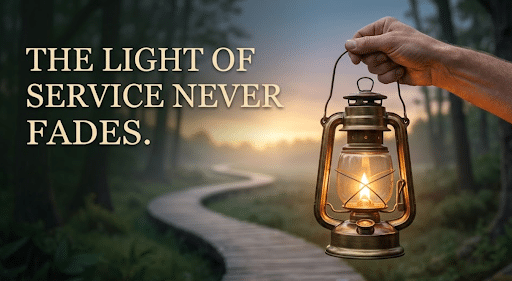
What Do You Want to Be Remembered For as a Leader?
Yesterday was Memorial Day.
For many people, that meant flags, ceremonies, family gatherings, and maybe the unofficial start of summer. But at its heart, Memorial Day exists for one reason: to ensure that those who fought for us, especially those who made the ultimate sacrifice, are never forgotten.
We remember them not because of their titles, résumés, or performance metrics. We remember them because they served selflessly and fought for something bigger than themselves.
While most of us are not called to make that kind of sacrifice, Memorial Day still invites an important question for all of us, especially those in leadership:
What do you want to be remembered for?
When your team looks back years later and says, “Remember when she was leading us?” or “Remember what he was like during that difficult season?”
What will they remember?
That you hit your KPIs? Exceeded quota? Sent beautifully formatted spreadsheets with impressive color-coding?
Sure, results, performance, profitability, strategy, and execution all matter.
But let’s be honest, a lot of those accomplishments are like half the Christmas presents kids receive nowadays: There is a burst of excitement when they first appear, but are quickly forgotten.
Leadership achievements can be like that too.
People won’t remember the dashboard, but they will remember whether you
- protected them or threw them under the bus.
- listened before deciding.
- had the courage to tell the truth,
- Were humble enough to admit what you did not know, or
- Demonstrated the steadiness to keep people grounded when everything felt uncertain.
In other words, they will remember whether your leadership was ultimately about you, or about how you served others.
Because service, at its best, is still the highest form of leadership.
Service.
Real leadership has never been about how many people report to you; it’s about how many of them feel stronger, clearer, safer, and more capable because of you.
That matters even more now, as AI reshapes how we work, write, analyze, plan, and communicate.
And given today’s “VUCA” world (volatile, uncertain, complex and ambiguous), service can be broken down into a number of components.

First, Service-Oriented Leadership Requires Clarity
When people are overwhelmed, confused, or uncertain, they do not need leaders to say more. They need leaders to make things clearer.
Clarity is an act of service because it reduces anxiety, helps people prioritize, and prevents the ever-popular “I thought you meant…” disaster.
A service-minded leader asks: What do my people need to understand in order to move forward with confidence?
Second, Service-Oriented Leadership Requires Steadiness
Today’s leaders may not be facing literal battlefields, but they are leading through burnout, economic pressure, rapid change, and AI disruption. In those moments, people are watching more than your words. They are watching your energy.
- Are you reactive or grounded?
- Are you hiding the truth or naming reality responsibly?
- Can they always bring issues to your attention, or do they need to see which way your mood is swinging?
During uncertainty, people look less for perfection and more for steadiness.
Third, Service-Oriented Leadership Requires Listening
In a world increasingly dominated by generated responses, genuine listening becomes rare — and therefore powerful.
Listening is not just waiting for your turn to talk, nodding while mentally drafting your rebuttal, claiming to listen while staring at your phone, or saying, “I hear you,” while your face clearly says, “I have already moved on.”
Listening to understand is an act of service because it tells people: You matter enough for me to be fully present.
Trust me: people remember that.
Fourth, Service-Oriented Leadership Requires Courage
Sometimes serving people means:
- encouraging them
- protecting them.
- telling them the truth they need, but may not want to hear.
That is not always comfortable. But leadership was never supposed to be a comfort contest.
Service requires courage because it asks us to put the mission, the team, the customer, the community, or the greater good ahead of our own ego, convenience, or desire to be liked.
That is where Memorial Day gives us such an important reminder.
The people we honor did not serve because it was easy. They served because they believed something mattered enough to protect, defend, and preserve.
Again, I am not equating office politics with military sacrifice. There is no comparison.
But there is a lesson: in every context, leadership is ultimately about responsibility for other people.
So as we move from Memorial Day back into the regular rhythm of work, meetings, deadlines, and decisions, remember the question:
What do I want to be remembered for?
Do you want to be remembered as
- The leader who always had the answer, or the one who empowered others to find their own?
- The leader who had to prove that they were the most important person in the room, or who made everyone else feel valued?
- The leader who protected their image, or the one who protected their people?
- The leader who demanded to be heard, or who made others feel heard and understood?
Because at its best, leadership is not about being impressive. It is about being useful, trustworthy, and committed to helping others do what matters most.
And that kind of leadership will never be obsolete.
Speaking of influence, communication, and what it really takes to lead in a way others can trust and follow, check out my conversation with Kimberli J. Lewis, “Speaking to Influence: Communication That Drives Impact” on her podcast, “Leadership Beyond Borders.”
- Why some people naturally command attention while others struggle to be heard,
- How perception and authenticity shape the way messages land,
- The role that perception, authenticity, and executive presence play in shaping how our message is received, and
- The fine line between persuasion, manipulation, and positive influence.
From choosing the right words and using storytelling effectively to managing first impressions and navigating difficult conversations, this episode is packed with insights you can apply immediately.
All of this contributes to the answer to the question:
When people remember you, will they want to honor the memory?