AI Can Write Your Message. It Can't Deliver It.
Use AI to sharpen what you say. Do not use it to say it for you. Here is where that line falls, and the seven-part prompt that gets you to it.
“It’s good, but…I hate to admit this…I really need you to just streamline this so I can skim and absorb it in about 30 seconds.”
This is the feedback I got from a friend and client who is the chief strategy officer of a large health care organization.
The focus: some new marketing material I had drafted, specifically one-pagers for my executive coaching, core training programs, and soon-to-be-announced licensing and certification program (which I’m really excited about).
We’ve known each other for years, and I’ve trained and coached many of his people. That’s why I was eager for his feedback: he knows me, he knows the experience I provide, and he knows the results I get.
He was the perfect person to gauge whether any of that was evident on the service flyers.
“Looking through your CSO lens, if you didn’t know me and just saw this one-sheet, what would be your gut reflex?” I had asked.
That’s when he opened the file and gave me that feedback I mentioned above.
-
More white space
-
More bullets
-
Shorter phrases
-
More bolded key words
-
Less context
“I basically need to instantly get it. When I get a one-sheet like this, I’m going to give it a quick once-over and then unless something totally grabs me, I move on.”
Ugh, I thought. I already got my life’s work down to one page! How much simpler can I make it?
Apparently, the answer was “simpler than that.”
Albert Einstein is credited with saying, “If you can’t explain it simply, you don’t understand it well enough.”
But the natural reflex is to defend ourselves by saying “That’s not true! I DO understand it exceptionally well; it’s just complex and complicated!”
The truth is:
- It’s easy to data dump; it’s hard to synthesize it into a “so-what” headline.
- It’s easy to ramble; it’s hard to streamline.
- It’s easy to speak in a way that reflects your own priorities; it’s hard to accurately reflect theirs.
- It’s easy to use big words that make you sound smart; it’s hard to find simple words that make the listener feel smart.
As each of these points suggests, the biggest challenge in getting people on board is making your point clear, obvious and intuitive for the listener.
And, as with most things that seem simple in principle, they are often easier said than done.

The Seven-Part Prompt: How to Write AI Prompts That Sharpen Your Message
Fortunately, this is one area in which AI can make your life much easier.
As a matter of fact, whether you use ChatGPT, Claude, Copilot, Gemini or something else, most platforms love it when you data dump all of your thought process into it as part of the prompt (or series of prompts) and then tell it to simplify.
Better yet, here is the Seven-Part Prompt, my framework for getting an AI platform to hand you something you can actually use. Give it all seven, in order:
- Name the audience and your role/relationship with them
- Set the context: what is happening, and what is at stake
- State your objective: the specific decision or action you want
- Assign the AI its role in guiding you e.g. should it be an expert in something specific?
- Spell out the audience’s likely mindset, priorities, concerns and objections
- Set your word count or slide limit goal (if there is one)
- Ask it for three to five common, everyday, real-world analogies for the situation (you’ll pick the best one)
And any other context cues that will help it streamline your message so it lands 10x more on-target than you could have done (especially in 10 seconds) on your own.
That’s what I did with my new flyer – and what it eventually came out with was a fraction of the verbiage of my original, but an order of magnitude greater clarity and impact.
When to Stop Using AI for Executive Communication
Yes, AI is an amazing sounding board.
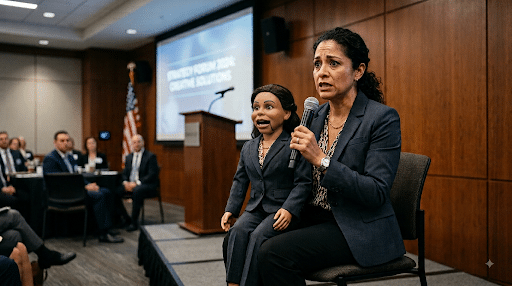
What it’s not is a great ventriloquist. (Which is good, because that would make you the dummy!)
Point being, it can help you clarify your points so that when you send the email or proposal, the response you get is: “Let’s talk.”
But at that point, it cannot do the talking for you. That’s when you have to stand on your own two feet, hold your own ground, and speak for yourself.
- AI can give you the analogy, but you need to share it in a way that makes you both feel like it’s a shared (and even universal) experience.
- AI can give you the headline, but you need to land it with mic-drop power.
- AI can help you choose the right words, but you have to own them as they come out of your mouth.
- AI can help give you authority in text, but you have to stand in your own power in person.
That’s why I love my new service flyers: they help decision-makers quickly and easily understand why they want to have a conversation with me…
But then it’s up to me on the subsequent Zoom or Teams call to confirm their initial instinct: Yes, these are the results we want, and this is the person to help us get them.
Do You Inspire Confidence, or Just Communicate Clearly?
This is the key:
When AI helps you find the words, it can give you the benefit of the doubt that you’re probably the right person for the job.
But when you can
- Land the message, face to face,
- Be totally congruent in your words, voice and body language and
- Project the perfect combination of confidence, expertise and emotional intelligence,
that gives them the confidence to trust that you are absolutely the right person for it.
For some people, these two things overlap perfectly and naturally.
“I’m as born for this as anyone else.”
For others, bridging the gap feels like trying to jump the Grand Canyon on a motorcycle like Evel Knievel (remember him?)
If you’re in the latter camp, it might be time to look for a coach.
Because that gap is the only thing standing between you and what you know in your heart that you’re capable of achieving.
That’s when “Beverly” called me. As the CEO, she knew her organization and industry, cold.
But she hated public speaking, especially standing in front of warring factions and struggling to get everyone on board… that was definitely on the other side of the canyon.
As we worked together, she gained confidence in how to connect, powerfully and authentically, even when the message would be hard to deliver, and even harder to hear.
Reporting back after facilitating a large and public meeting around sensitive and unpopular topics (which we had prepared her to address), she observed:
“It went really well, and I realized, I’m as born for this as anyone else.”
That confidence is something no AI platform can give you.
Related reading: Does AI Sound More Human Than You Do?
Frequently Asked Questions
Can AI write executive communications?
AI can draft and sharpen them. Give it the audience, context, objective, constraints and likely objections, and it will cut a bloated message down to something clear. What it cannot do is judge whether the result still sounds like you, or deliver it in a room where people are watching you say it.
What can AI not do in leadership communication?
It cannot establish credibility in person. Trust is built through congruence between your words, your voice and your body language, and through the confidence you project under pressure. AI can earn you the meeting. Once the meeting starts, the persuading is yours.
How do I write a better AI prompt for a business message?
Use the Seven-Part Prompt: name the audience and your relationship with them, set the context, state your objective, assign the AI its role, spell out their likely mindset and objections, set your length limit, and ask for three to five real-world analogies to choose from.
Why do my one-pagers and proposals still feel too long?
Because synthesis is harder than explanation. Most experts default to context and nuance, which reads as a data dump to a senior decision-maker giving your document one quick pass. The fix is a so-what headline first, then short phrases, white space and bolded key words.