“Wow… I never knew that was even a thing! I thought it was just me.”
I have heard this response from countless clients over the years, and always when I've introduced the same concept: imposter syndrome.
The profiles range from a first-time plant manager at a textile production factory to the CFO of a medical supply company, and everything in between.
Imposter syndrome is the persistent fear of being exposed as a fraud despite clear evidence of your competence.
Psychologists Pauline Clance and Suzanne Imes coined the term in 1978 to describe that awful voice of the inner critic that says, “You're a fraud. You don't belong here and everyone knows it. You'll never be good enough.”
Here's the part that tends to get lost: usually, the biggest problem is your own impossible standards. Then you quietly project those standards onto everyone else in the room and assume they're the ones keeping score.
In eighteen years of coaching executives, I have yet to meet a person who is fully immune.
It's true that women have historically carried it more than men and professionals, that professionals from minority backgrounds have carried it more than their white peers, often stemming from being “the only one” in a group, and conditioned from times where they were unfairly judged as a result. But it is not theirs alone.
One (white male) CEO of an international company said to me, “I know I have some imposter syndrome. But I’m the CEO, so all eyes ARE on me, and if the company doesn’t do well, I’m out. So I just have to recognize it and push through it.”
But here’s the good news: at its core, imposter syndrome isn't a competence problem; it's a communication problem — and it starts on the inside.

The 5 types of Imposter Syndrome and the broken record each one plays
Clance and Imes identified five distinct flavors of the imposter syndrome. What I want you to recognize is that each comes with its own “broken record” — a signature phrase the inner critic repeats until it sounds like fact in your head.
- The Perfectionist sets impossibly high standards and treats anything short of flawless as failure.
The broken record: “It should have been better,” even though the work is objectively excellent. - The Expert measures worth by how much they know.
The broken record: “I should already know all of this, too.” Even a small knowledge gap registers as failure. - The Natural Genius believes competence should arrive effortlessly.
The broken record: “This is hard; I just don’t have what it takes.” Struggle isn't viewed as proof you're growing; it's proof you're a fraud. - The Soloist insists on doing it all alone.
The broken record: “If I ask for help, they'll know I couldn't handle it myself.” Collaboration doesn't feel like leadership. It feels like an admission of weakness. - The Superperson tries to excel in every role at once — leader, parent, partner, mentor, top performer.
The broken record: “Everyone else seems to manage. Why can't I?” The bar isn't just high. It's everywhere, all the time.
Read those back and notice something: Every single one is a criticism you throw at yourself.
How Imposter Syndrome sabotages your communication
Here's why this matters far beyond your own peace of mind: That internal script doesn't stay internal. It leaks into how you show up, and it distorts what you hear.
Outward, it changes how you show up — and not always in the same direction. For some, it shrinks you, e.g.:
- You keep second-guessing yourself and miss the window of opportunity.
- You over-prepare and still hedge — “I might be wrong, but…” — handing away authority before saying anything worth hearing.
- You swallow the question that would have saved the project.
For others, the very same fear does the opposite: it makes you overcompensate.
- You talk too much to fill any silence that might be mistaken for ignorance.
- You point out someone else's flaw before anyone has the chance to notice yours.
- You bark “figure it out yourself and stop asking for help,” imposing on everyone around you the same impossible restrictions you've imposed on yourself.
Shrinking and overcompensating look like opposites, but they're the same voice. Either way, the audience doesn't hear your résumé. They hear your fear.
Inward, the imposter’s syndrome can also make you a little paranoid. Let’s face it, when you already feel unworthy, it’s easy to start reading judgment into words and behavior where none exists.
Maybe your boss was just distracted, but you see her lack of interest as proof you disappointed her. Or maybe you interpret your colleague's short reply as a verdict on your worth, rather than realizing you were interrupting his race to meet a deadline.
Left unchecked, the reflex can become a habit: You assign negative intentions to people who never had them, create a story around those intentions, then respond to the story instead of the person.
How to quiet Imposter Syndrome and rewrite the script
You probably can't evict the inner critic right away. But you can:
- Shut it down before it gets to finish its thought
- Refuse to let it run its agenda
- Redirect the focus and control the narrative.
Start by catching the phrase. When the “I’m such an idiot” shows up, name it for what it is — a worn-out line, not a truth.
Then ask a more useful question, e.g.: “What does this moment actually require, and how can I deliver it?”
Notice it’s not a yes-or-no question. It’s a choice you can make.
Similarly, when you catch yourself assuming someone's judging you, try the same discipline outward. Ask yourself: “What other reason could there be for that person’s response?”
The key is to check the evidence before you react to the story.
Bottom line: You're not a fraud. You're just fluent in a language that was never telling you the truth. Time to learn a new one.
If you want to start learning that new language, I go deep on it in two recent conversations worth adding to your commute:
First, on the Executive Connect Podcast, host Melissa Aarskaug and I get into why technical brilliance is only the starting point.
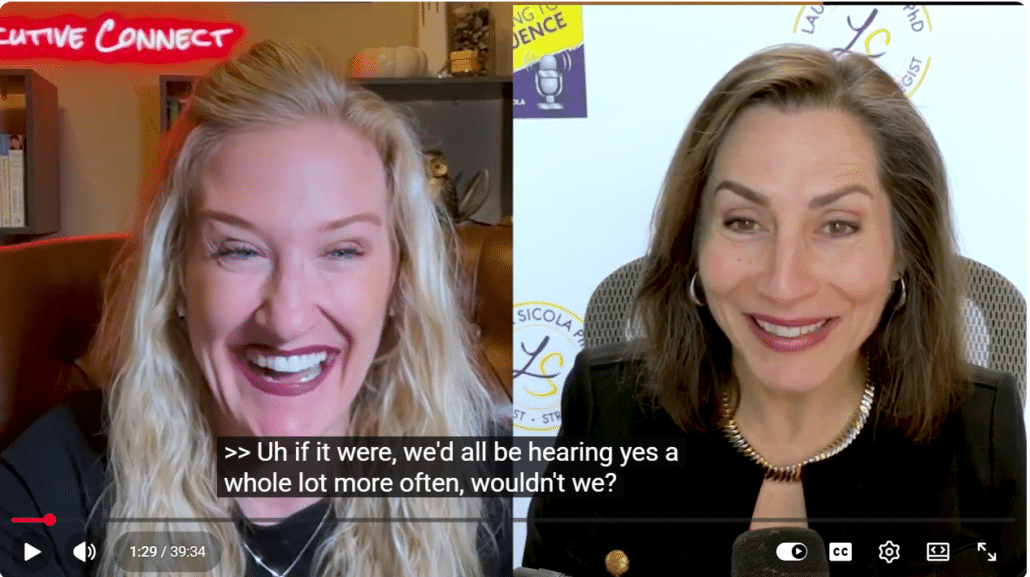
We explore how effective leaders authentically earn buy-in, why your personal brand is built in the ordinary moments rather than the big presentations, and my three Cs of executive presence and strategic influence.
Then, on Going in Blind with Zach Tidwell, we go further under the hood — into cognitive linguistics and how the brain actually processes language.

We dig into why experts so often fail to translate their expertise to everyone else, how much of your message lives in everything other than your words, and what neurolinguistic programming is, and why it’s a tool whose power is in the details. Listen on Apple, Spotify, or YouTube.
Ironically, we all want to be recognized and appreciated for who we are. But how can we expect others to truly see us if we allow the imposter syndrome to distort our own view of who we are?
Frequently Asked Questions About Imposter Syndrome
What is imposter syndrome? Imposter syndrome is the persistent fear of being exposed as a fraud despite clear evidence of your competence. Coined by psychologists Pauline Clance and Suzanne Imes in 1978, it's the inner-critic voice insisting you don't belong and will never be good enough — usually measured against your own impossible standards.
What are the 5 types of imposter syndrome? Clance and Imes identified five: the Perfectionist, the Expert, the Natural Genius, the Soloist, and the Superperson. Each one runs its own “broken record” — a signature phrase the inner critic repeats until it starts to sound like fact.
Is imposter syndrome a sign that I'm actually bad at my job? No. Imposter syndrome shows up precisely in competent, accomplished people. It's a self-perception and communication problem, not a competence problem — the fear is manufactured internally, in the absence of anyone actually telling you that you don't belong.
How do you overcome imposter syndrome? Start by catching the inner critic's phrase and naming it as a worn-out line rather than a truth. Then replace the yes-or-no question (“Am I good enough?”) with an actionable one: “What does this moment actually require, and how can I deliver it?” Apply the same discipline outward by checking the evidence before reacting to the story you've built about how others see you.
Why does imposter syndrome affect how I communicate? Because the internal script doesn't stay internal. It leaks outward — making some people shrink (hedging, over-apologizing, staying silent) and others overcompensate (over-talking, deflecting, criticizing others first) — and inward, distorting how you interpret other people's words and intentions.