There’s nothing quite like asking a question—and having the other person laugh in your face.
Not necessarily in a mean way. But it happens surprisingly often.
One of the most common reasons leaders reach out to me for coaching is that, despite their confidence in their skill and expertise, they dread presenting at board meetings and other high-stakes moments.
Sometimes they don’t even like the spotlight in weekly leadership team updates. And forget about speaking on a panel or a podcast.
“I just want to not hate it,” they say.
“Well, we can definitely get you to that milestone,” I tell them. “But how about we aim a little higher? What if you could tap into your natural charisma—and actually learn to love public speaking?”
That’s usually when they burst out laughing.
Not out of disrespect, but at what feels about as realistic as hitting the lottery… twice.
Why “charisma” feels like a four-letter word
For most people, charisma is a scary word. It conjures exaggerated images of larger-than-life personalities: Tony Robbins, stereotypical televangelists, or the off-the-charts extrovert who seems desperate to be the center of attention.
Which is unfortunate—because the real definition is far less extreme, far more empowering, and (whether we like it or not) essential for leadership.
According to Olivia Fox Cabane in her book The Charisma Myth, charisma is nothing more than the combination of three factors:
- Competence
- Presence
- Warmth
Competence shows others you have the skill to serve them and meet their needs.
Presence is the grounded confidence of who you are—how you show up when it counts.
Warmth signals you’re not going to use your competence to harm them; you’re safe, trustworthy, human.
When you break it down like that… is it really so complicated?
If you’re not “magnetic,” it’s usually not a personality problem
If you’re not projecting that natural magnetism—the kind that makes people lean in and actually want to listen—it’s rarely because you “weren’t born with it.”
It’s usually because on some level, one of those three factors isn’t coming through. And most often, that gap has nothing to do with your actual ability… and everything to do with what you believe about yourself.
Most likely you started out with that confident charisma but then at some point:
-
We get judged.
-
We get corrected.
-
We get mocked or shut down.
-
We get punished for being expressive, rather than guided on how to make the expressiveness more contextually appropriate.
In other words: it’s not that you’re incapable. It’s that you don’t fully trust yourself anymore.
Madeline didn’t need to love it. She just wanted to stop dreading it.
That’s why when Madeline, an executive at a global asset management firm, came to me for public speaking coaching, her goal was simple: “I just want to not hate it.”
Six months later, I asked, “So… how are we doing with that goal?”
She smiled ear to ear, shook her head, and said—still a little incredulously:
“When you said to aim higher, I thought you were crazy. So I can’t believe I’m actually saying this… but I don’t just not hate public speaking. I actually love it!”
Here’s what changed: yes, she learned the skills to do it well. But more importantly, she found her voice—her purpose—the impact she wanted to have every time she spoke.

Meetings became opportunities, not obligations.
Panels became fun.
Podcasts became play.
Instead of trying to “get through it,” she started showing up with a personal mission: add unique value every time.
And the feedback loop mattered. The more her audiences (live and virtual) reinforced that she was landing the message, the more her confidence grew.
It wasn’t hype. It was evidence.
Soon, she wasn’t just good at speaking—she became her department’s go-to speaker for key events. Her boss (who also hated public speaking, and kept getting invitations) started handing them to her as his proxy.
And she loved that.
So what was the secret?
The pattern behind “boring” speakers is painfully consistent
Madeline’s story is one of many. Most leaders walk in with some version of these beliefs:
- “What I share in meetings isn’t that exciting.”
- “My subject matter is too technical—no one wants to hear about this.”
- “I don’t like being the center of attention,”
- “I just want to get it over with.”
Look at the pattern. No wonder the delivery feels flat—if you don’t seem interested in what you’re saying, why should anyone else be?
Here’s an uncomfortable leadership question:
Are people energized after hearing you speak… or quietly relieved when you stop?
Charisma isn’t something you “get.” It’s something you allow yourself to share.
The shift starts with mindset. Finding the trigger that unlocks that shift is the key to opening the door to your natural, effortless charisma—the kind that makes people genuinely want to listen.
The transformation in how you feel inside (and what your brand becomes externally) can look like magic.
But the beauty is that it’s 100% authentically you.
Most people think charisma is something you’re either born with or not.
And the truth is: they’re half right.
You are born with it.
Yes, I’m talking to you. You were born with charisma. So was everyone else.
Then at some point, we either learn to cultivate it… or we learn to deny it.
As adults, we start sorting ourselves into the “haves” and “have-nots,” as if charisma is a genetic inheritance instead of a human capability.
But the beauty is this: all of us, at any time, can hone our natural charisma—take back our voice—and maximize our competence, presence, and warmth.
It’s not hard. It is essential. And yes… it can be fun.
Want to see what that looks like in real life?
If you’re thinking that strengthening your charisma and executive presence would help you land your next role—or simply show up with more confidence in the one you have—check out my conversation with Julie Noonan on the Roaming with Restless Women podcast.
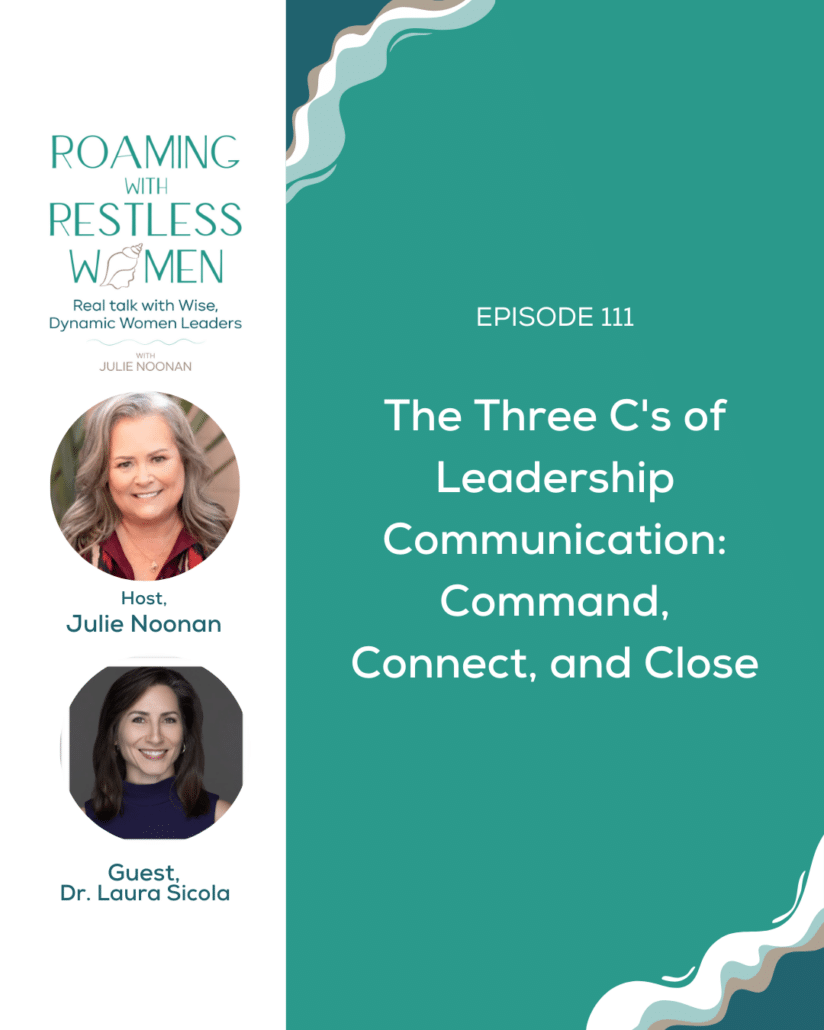
We talked about:
- my circuitous career journey into executive coaching
- the power of authentic communication
- generational differences in workplace communication
- the importance of personal branding
- and how it ties into my “three C’s” framework for leadership: Command the room, Connect with the audience, and Close the deal.
So the next time you burst out laughing…
…let it not be at the idea of loving public speaking—or the notion that you could ever be truly good at it, much less “charismatic.”
Let it be the sound you make when you realize how long a limiting belief kept you small… and how good it feels to finally outgrow it.
Comfortable in your own skin. Clear in your message. And steady at any microphone—no matter the room, the board, the panel, or the spotlight.
It's already in you. Now it's time to set it free.