
Out of pure curiosity, amid all the fanfare for America's 250th anniversary this past Saturday, I tuned in to an unlikely source for coverage: the BBC.
Their episode, “The Global Story: the US at 250,” worked through the cultural, economic, and geopolitical angles of American influence. But one line stopped me.
A commentator relayed something he'd heard people say around the UK:
“The problem we've got is that America had our revolution. The people who should have had a revolution in this country went to America to have it.”
It’s about aspiring and holding ourselves and each other to higher standards and expectations, for leadership and members alike.
The Declaration of Independence was a statement of identity, a clear articulation of values, a vision for the future, and an invitation for others to commit to a shared cause.
To the BBC's credit, the coverage was fair: they gave examples of where we've been a role model and where we've fallen short of the ideals the Declaration of Independence codified 250 years ago.
No nation (or individual) lives up to its stated ideals perfectly, but what they stressed was that the best we all can (and must) do is celebrate the wins, be candidly honest about the failures, and keep trying to be better.
That's not just national leadership. That's every kind — corporate, community, family, individual.
Which raises a question worth sitting with this week:
What are you declaring through your leadership communication — and does what you profess match what you live out through your words and actions?

Leadership Itself Is a Declaration
Like the Declaration of Independence, leadership isn't only about directing activity; it's about declaring who we are, what we believe, what we will and won't accept, and where we're headed together.
And here's the catch: you're making those declarations every day, whether you intend to or not.
- Your words
- The stories you tell
- The behaviors you reward (or embody)
- The issues you choose to ignore
all announce what you truly value, regardless of what you proclaim.
The Four Declarations Every Leader Makes
Strip it down, and every executive is constantly making four.
- A Declaration of Values. Your principles show up not in a mission statement but in your tradeoffs — the priorities you defend when things get hard and the behaviors you model when no one's keeping score.
- A Declaration of Standards. Culture is shaped less by what you aspire to and more by what you permit. Every leader declares and demonstrates what excellence looks like, what accountability means, and what's simply unacceptable.
- A Declaration of Vision. People don't just want tasks; they want purpose and a part in something larger. Great leaders make clear why the work matters, what future they're building, and how each person's contribution fits.
- A Declaration of Identity. Teams need to know who they are: what makes them distinct, which principles set their culture apart, what reputation they intend to earn. Identity is what turns a group of employees into a unified team — and communication is the mechanism that does it.
Why the Gap Between Intent and Impact Matters
Most leaders assume they're sending one message, but their teams are receiving another. My entire body of work lives in that gap — the space between what a leader thinks they said and what their audience actually heard.
So the question isn't “What message am I trying to send?” It's the harder one: “What message are people actually receiving?”
To help you answer it, here’s a quick self-audit, with one question per declaration:
- Values: If your team described what you care about most, would their answer match your intent?
- Standards: What behaviors do you consistently reward, tolerate or demonstrate, despite saying otherwise?
- Vision: Can your people articulate where you're headed, and why, in their own words?
- Identity: What do you want people to say about working with you — and would they say it today?
Executive Presence Is a Declaration, Too
Executive presence isn't just charisma or the ability to command a room.
At its core, it's a declaration — of confidence without arrogance, clarity without rigidity, conviction without hostility.
Strong presence quietly answers the questions every follower is asking:
- Can I trust this person?
- Do they know where we're going?
- Do they stand for something that matters?
People follow certainty, especially in times of ambiguity (like the “VUCA” world we’re in today) — and certainty is something you declare, both explicitly and implicitly.
The Takeaway
The Declaration of Independence endures not because of what it opposed, but because of what it clearly articulated and invited others to embrace, with the implicit promise of working to build that promise together.
New: The Leadership Language Radio Series
Want to discuss what this kind of verbal and nonverbal declaration of leadership looks like?
After a great first conversation with Kevin Price on his Price of Business show a few weeks ago, I'm thrilled to launch a new monthly radio series — Leadership Language: Learning to Lead — syndicated across the US and distributed by USA Business Radio.
Each month, we'll decode real business headlines through the prism of how leaders communicate, persuade, and lead: real-world case studies, listener questions, and the keys to executive presence and influence. Tune in!
Podcast of the Week
Just as important, these principles don't stop at the conference room or the Zoom call…
Communication is the foundation of every healthy relationship, including at home.
This week I had the pleasure of joining David Anderson on The Wedding Chaplain Podcast (Episode 67: Communication) to talk about communication as one of the cornerstones of a strong marriage.
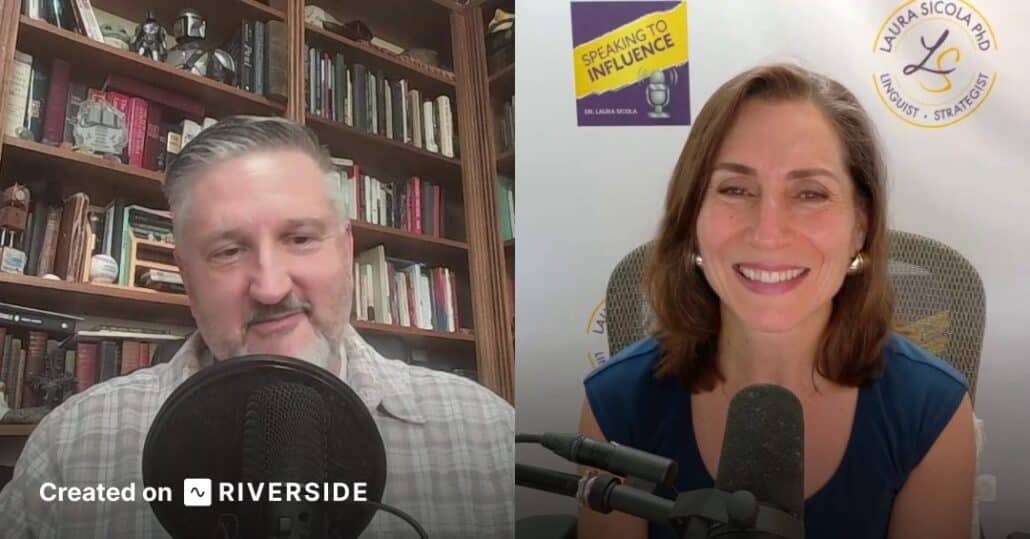
Let’s face it, wedding planning can be an emotional rollercoaster. It surfaces big decisions, family expectations, financial conversations, and real emotional pressure.
That’s why David and I dug into how couples can communicate with more clarity, confidence, respect, and connection through all of it…and more importantly, in the daily rhythm of married life long after the ceremony.
Whether you're engaged, newly married, or simply want to communicate better with someone you love, there's practical wisdom here for building trust one conversation at a time.
Final thought:
So today, I invite you to take a moment to ask yourself: if your team — or your family — had to write a “Declaration of Leadership” based solely on your verbal and nonverbal communication, what would it say? And would you proudly sign your name to it?