“So you're saying we have to dumb it down?”
It's one of the most common questions I hear from technical experts who are struggling to get their point across and be heard the way they want to be heard. And here's the irony: these are often the smartest people on the team — the deepest technical experts, the most experienced, the highest performing.
They're frustrated because they've done all the analysis. They have the answers. They've shown the data, explained the background, delivered the recommendation… and still, they're not hearing yes.
Why Smart Experts Don't Get the Green Light
After a while, you get tired of banging your head against the same wall. You want to grab someone by the shoulders and say, “Trust me — I'm smarter than you in this area, so you just need to accept that I'm right and do what I'm telling you to do.”
Naturally, you can't indulge that impulse — physically or verbally. But you still need the yes. You need the buy-in to move the needle forward.
That's where I come in. And I usually start with a piece of advice that sounds completely backwards:
If you want people to believe you're smart, the best way to do it is to make them feel smart.
And even more counterintuitively, the easiest way to make them feel smart is to simplify your message — to make your point so crystal clear that they instinctively think, “Of course. That makes perfect sense.”
4 Tools to Simplify Your Message (Without Losing the Substance)
To get there, I give experts four tools. Use them and watch how quickly people start nodding along:
- Strip away the jargon and acronyms. Speak in plain English, and favor small words — one or two syllables is just fine. (REALLY.)
- Reach for an analogy or metaphor. Connect your key point to a common, simple experience your listener is guaranteed to relate to. Then fill in the details from there.
- Pick one, two, or three data points. Max. Less is more. Identify the elements that pack the biggest punch, and keep the rest in an appendix or in your back pocket, ready when asked. Don't drown them in numbers and expect a thank-you.
- Tell a story or use a case study. Paint the picture in practical, tangible, personal terms — what has happened, or what's about to. If it's forward-looking, show either the positive future they'd want to build or the warning you both want to avoid.
Inevitably, when I share these four tools, the initial response is a slightly deflated sigh: “So you want me to dumb it down?”
To which my answer is always the same: On the contrary — I want you to smarten it up.
They're usually a little incredulous. So I remind them that Einstein said, “If you can't explain it simply, you don't understand it well enough.”
They might doubt me. Nobody doubts Einstein.

Why These 4 Communication Tools Actually Work
This isn't a stylistic preference. There's cognitive science underneath each one:
Plain words remove the cognitive delay.
Jargon and acronyms may be technically correct, but big words take more time to process. Your listener might understand them — but only after making the face that looks like they're doing long division in their head.
Small words get digested instantly. They get it, without having to work to get it.
Analogies and metaphors speak to the unconscious mind.
A good comparison triggers a physical or emotional memory, and that reflex fires instantly.
Now you're both starting from the same place — a position of relatability and empathy — which paves the road for everything you say next.
Less data prevents overload.
People want you to tell them the “so what” — not make them assemble the numbers themselves. Reality check:
- Could they connect the dots if they had as much time as you did to analyze it all? Sure.
- Do they have that time? No.
- Even if they did, would they want to spend it on that? Definitely not.
A story brings the concept to life.
A picture is worth a thousand words, and a well-told story — real or hypothetical — is worth a thousand pictures. It lets your listener envision a reality, desirable or not, and makes them feel it.
Stories conjure emotion, and emotion moves the needle far faster in helping people appreciate a new perspective.
The Real Reason Experts Resist Simplifying
The hesitation so many experts feel makes sense. Asking them to set down their data, jargon, and technical firepower is like asking Superman to take off his cape. They feel empty-handed, vulnerable, exposed.
But when we work through how to actually wield these tools — like we do in my Breaking the Expert's Curse workshop — something shifts. People watch their own before-and-after transformation videos, just a couple of hours apart, and the most common reaction is:
“I can't believe it. When I hear myself use these tools, I actually sound smarter and more confident — and my argument seems stronger!”
So, back to the question that started us off: do you have to dumb it down?
Not at all. When you simplify your message, you don't sound dumber — you sound sharper, clearer, and more in command of your own expertise.
You're not dumbing it down. You're smartening it up.
Counterintuitive? Perhaps. Powerful? Absolutely.
Want to Go Deeper? Two Resources Worth Your Time
If you've ever walked out of a meeting thinking, “I know my idea was strong… so why didn't it land?” — I joined Ilene Schaffer on What's Possible to tackle exactly that.
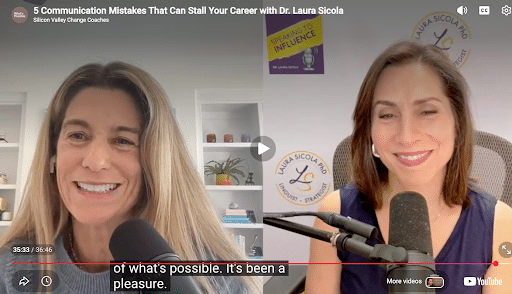
We dug into five common communication blunders that can quietly stall not just a conversation, but a leader's career — and what to do instead.
We also got into what it really takes to build authentic authority, executive presence, and influence in high-stakes conversations.
It's not about becoming someone else; it's about making sure your message lands with clarity, confidence, and impact. Big thanks to Ilene and the SVChange team for such a thoughtful conversation.
Listen on Spotify, Apple Podcasts, or YouTube.
Speaking of counterintuitive ideas — I recently explored another one with JV Crum III on the Conscious Millionaire Show.

We dove into “the truth about authenticity” and why “just being yourself” might be the most self-limiting decision you can make.
Whether you're scaling a business, making your next career move, or simply trying to perform at your highest level, this one offers a fresh lens on getting the results you want while being both fully authentic and effective.
Listen on Apple Podcasts or Spotify.
Ready to Smarten It Up?
Remember: Brilliance that nobody understands isn't influence — it's just noise with an MBA.
Whether you're presenting to the board, pitching a prospective client, defending a budget, or finally getting that brilliant idea past the people who keep saying “not yet” — the secret was never knowing more. It's how to make what you know land.
The good news: clarity is a skill, not a personality trait, and it's entirely learnable.